


A Dialogue on Prayers to Saints
The setting is imagined. Samuel is speaking with a Catholic priest named Fr. Michael.
Samuel: Why would I pray to the saints in the way of your popular piety? To the saints in this way and not Christ? As if one should only speak with their mother and not their father directly? This seems a foreign thing.
Fr. Michael steps back and is off-kilter. He has many memories—precious memories—of asking the saints for their help, for their prayers, and many miracles have happened in his life, the lives of his flock, and the lives of those he loves after these prayers were uttered—with earnest and faith and gratitude and love.
“How can he discount the great cloud of witnesses?” Michael asks himself.
Samuel: The affront that you feel in your spirit, the… the taken aback which you sense… you need to look at and recalibrate. This is not disrespect. I have prayed my entire life to my Master, and my Master alone. I have learned my entire lifelong, to this day, how to commune directly with my Lord and my God in Jesus Christ—my High Priest, my intermediary, my intercessor.
I have prayed to the Lord in my heart, and with my voice and with my song—never-ending and never another. But you would say to me that I should replace some of those prayers with prayers to saints? Who are my brothers, who are my fathers, but are not in themselves God?
Fr. Michael: “Well, no—don’t pray to saints. Ask them for their prayers.”
Samuel: “Why?”
A Son’s Right
I need no intermediary. If I have direct access to Christ, and in Christ the Father—whom He reveals by the power of the Holy Spirit made manifest in my life and soul—why should I ask for another saint’s prayers, if directly I go to the Lord? Only He can heal me. Only He can receive what I am and transform me while still making me His own, without robbing me of my own personality.
He is God. He is God; He is not a man. He takes nothing from me; He only gives, while making me entirely what I am meant to be. He is everything and more. He is everything and more. All the mysteries and treasures of wisdom and knowledge are hidden in Him, and in Him alone. How can I possibly put someone in between… someone in between He and I? When my entire life I have trained tirelessly as a Protestant to pray to Him alone and hear His voice—not the voice of another. For the sheep recognize the voice of their master and come when he calls.
It is a son’s joy and right to have the capacity in him to recognize the voice of his father - and smile. And it is a son’s right to train after his new birth and through both his new birth and efforts to become likened to his Father—until their wills match and his Father’s voice is as recognizable as his very own self.
I need no intermediary, for Christ Himself has done this work. And it is a glorious mercy.
The Mother
However, Fr. Michael, I do not want to say that there is no benefit in the great choir and chorus of saints. For to be a son is to recognize the voice of the Father, and also the Mother—Mother Church—through which, indeed, Christ has made me.
I am a son of God and I am a son of the Church. A son of history. And because of this, I can recognize my mother’s voice in the sounds of the saints: in their writings, in the liturgies, in the choirs, in the poetry, and the acts of extreme kindness and mercy; in just war theology; and in the everlasting prayer, “Christ, have mercy on me.” I can recognize the voice of my mother, my brothers, my sisters, the saints.
Catholic and Orthodox, West and East, universal… resounding through the corridors of eternity and time. And those who have died are not dead but are alive in God—still singing now with the angels and the choirs of heaven, and indeed praying before the throne, beneath the throne of grace and mercy, that the Lord would come and make Himself… make His kingdom manifest in the earth. I can see these things.
I understand that the saints are alive in God. They can be nowhere else, for we all partake of one bread, one body, one Eucharist. And those who are in Christ are alive forever. Eternal life is their lot. Eternal life is their inheritance. And deification is their eternal destiny—in the light and the mercy and the love of God.
Sea of Glass and Cloud of Witnesses
Still, my brothers—this great ocean of witnesses, this great cloud of witnesses—parts when I enter the throne room. They would not stand between me and God. They would not stand between me and the Master, who alone sits on the throne, who alone is worthy to take the scroll and open the seals. They would not stand between the Lamb who was slain and His reward.
Which is me. Which is my heart.
The reward of His suffering. The saints would not stand between Him and His reward, for He is an all-consuming fire. Nor would they rob me of my God. Nor would they rob me of His voice.
This is why it says, even in your own theologies, that Mary’s whole job is to redirect. Someone prays to Mary; she is supposed to redirect them to the Christ. But many never go to the Christ—they only stop at Mary. This is a grave tragedy. It is not piety; it is a loss. It is a loss of fellowship with the only God we can ever know. And it has led to many pains—like the Mediatrix, and an abuse of the title Theotokos. It has led to many pains. Not to damnation, but to pains, I would say.
This is my own sense, that I believe comes to me by means of the Holy Spirit. Not everyone shares my view that these sins do not lead to death, but I believe they are wrong.
They Part the Sea
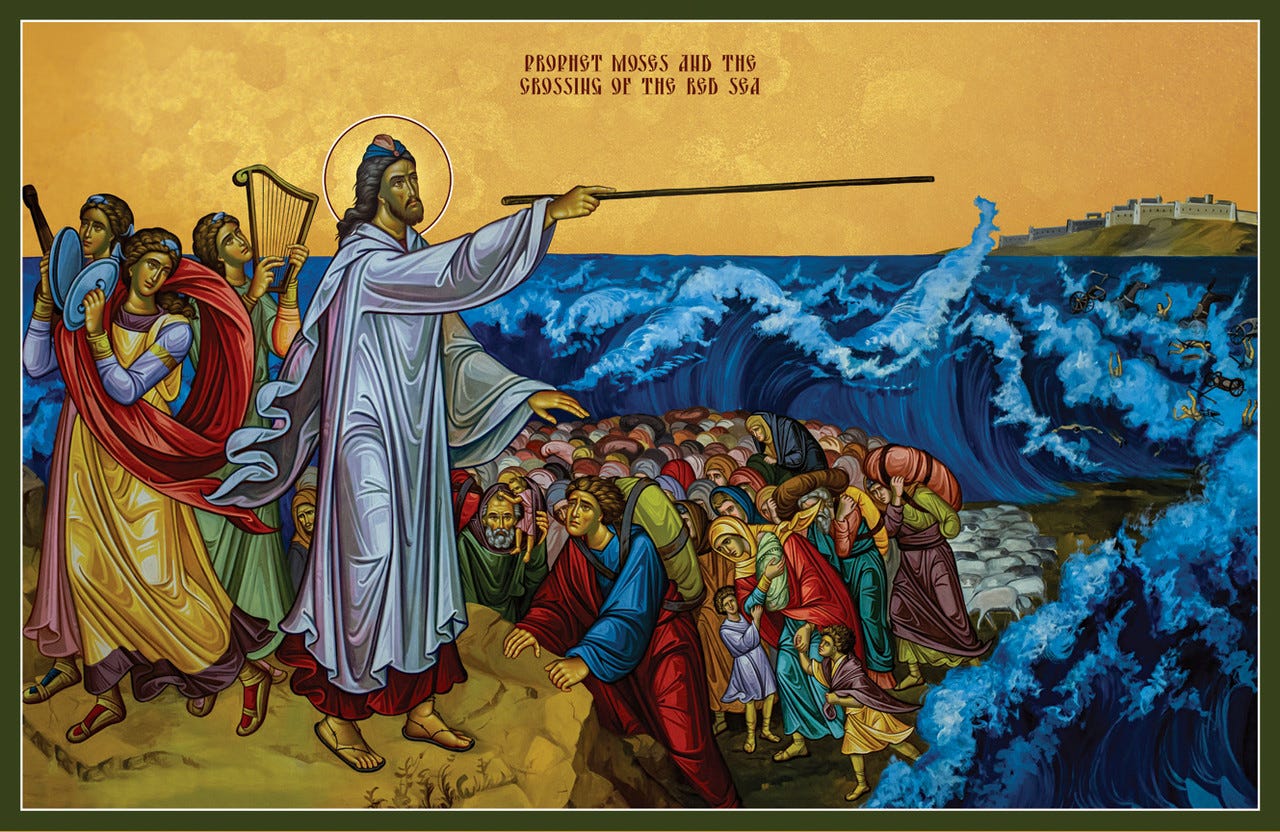
Fr. Michael, I do not discount the great blessing of Mother Church, the great mercy of the choir of saints. But their role is not as an intermediary. Their role is to part the sea for me—and hold the waters back—so I can make my exodus every day, in my own life and mind and heart, and re-approach the throne of grace.
They part the sea for me. They are the means by which God has brought me here, and the means by which He has decided to open up the world before me—that I can walk through it on a straight and narrow road and indeed enter into His glory.
Now to the Saints
My brothers and my sisters, without you I could have never seen His face. I am so grateful for you, O choir of mothers and fathers, brothers and sisters and saints. My heart is open to you and my whole soul rejoices in God my Savior because of you.
I am your son, and I take it as my responsibility to point all that I can to Mother Church and Christ Himself, who gives us being.
Now Returning
I am no enemy of my history and the souls that are alive in God, through which He has formed me. But at the same time, because of them, I have access to the Father. If I pray to them, I simply thank them. If I speak about them, I glory in their hard work and ministry.
Their role is to hold back the darkness. Hold back the waters of the sea.
Lived Experience
And as I see in my own life, when I read the words of Maximus, of Palamas, of Augustine—they confirm me in my madness. For I have become, in my own spiritual experience, like lightning—and seen many worlds all colliding in my own soul, and then re-gathered before the Maker.
I have seen in my own spiritual experience that beauty ever ancient, ever new—but I would not have had those words to describe the restless heart which only rests in Him, if it were not for my father Augustine. And I can see in the whole created order the sense made through the Incarnation, which I could not understand by the power of the Logos if it were not for Maximus making sense of Dionysius—if it were not for Maximus making plain the logoi in many things.
My fathers and my mothers, my brothers and my sisters, do hold back the sea for me to see my Master. And as I pass by them, they confirm me in my madness—hand on my shoulder—and give me many gifts in my arms. Many books. Many precious things. Frankincense. Myrrh. And gifts of gold.
That I can carry in my being, that become part of my soul. And so when I finally arrive face to face with my God, I am recognizable to Him. I am made more like Him by passing through this great cloud of witnesses who made for me an open road—this great cloud of witnesses which confirm me in my madness and let me know that I am not alone.
But I am in His home—we are all in His home, not the home of another. I exist, we exist, in His love because we exist in the world, in the cosmos, in His cosmos. And I exist, we exist, because we live forever in His home—in the Church, in the Church which has birthed me, and all who surround me in my generation, by definition. And I recognize my Father in Christ and my Mother in the Church.
And for these reasons, I do not ask the saints for their prayers.
Natural Communion without Barriers
I do—often—feel a special communion with the saints, and that they do somehow help me, and I am not closed off to their ministry. Especially while reading a saint’s writings, I naturally sense a request, a prayer rising to, not through, my friends who are alive in God, asking them to teach me and show me the things Christ made plain to them; and like incense the request, rising from the heart, comes to the voice; and I can sense a response from all who are alive in God. And this is a mercy from the choir of saints, and some in their specificity.
This feels natural to me, and takes nothing from Christ’s ministry in my soul, for I have already asked the Master for His guidance. What can a son do but ask his Father and Mother for advice? His being, his body, is derivative from both. Strange it would be, to never speak to the Father and see mother as intermediary… a good mother would avoid this at all costs.
Fr. Michael: “…these analogies and confessions echo…an ancient way of doing things, certainly.”
For my reader,
I share these things because I want the very best life for you;
the very best life in Christ.
This is my prayer
and these;
these are my Confessions.